Life is a series of forks that lead us toward an unknown destination. Most of those forks are decisions that seem unimportant at the time. Put together, however, they shape our future. Some decisions or events stand out in our memory, like watching a simple travel video on YouTube and deciding to drop everything and leave for the other side of the world. Today I want to tell you about a simple decision I made in 2014: buying Geoff Colvin’s book Talent Is Overrated: What Really Separates World-Class Performers from Everybody Else. This book pushed me to move from a part-time marketing certificate to full-time graduate studies. It changed how I saw myself and convinced me to keep pushing my limits. In this article, I explain how I broke through the psychological barrier created by the idea of talent.
How do I understand the word talent?
We often describe someone as talented. Whether the field is artistic, athletic or intellectual, the word comes up constantly. In sports especially, we often say that elite athletes make their performance look easy. At the other end of the spectrum, many people convince themselves that they have no talent for something and quit before they have really tried. The problem with this definition of talent is that it assumes some kind of divine spark that makes a person extraordinary at something without requiring much effort. This book made me understand that this definition was wrong. Talent is only a predisposition to improve faster than someone else for the same number of practice hours, or the ability to exceed a performance ceiling that someone with less talent could not cross. For a person who is not limited by a mental or physical disability in the activity concerned, the most important variable that remains under our control is, without a doubt, the number of hours of deliberate practice. Does our genetic inheritance affect what we can accomplish in each hour of practice? Certainly. Can we change our genetic code? Unfortunately not, or not yet!
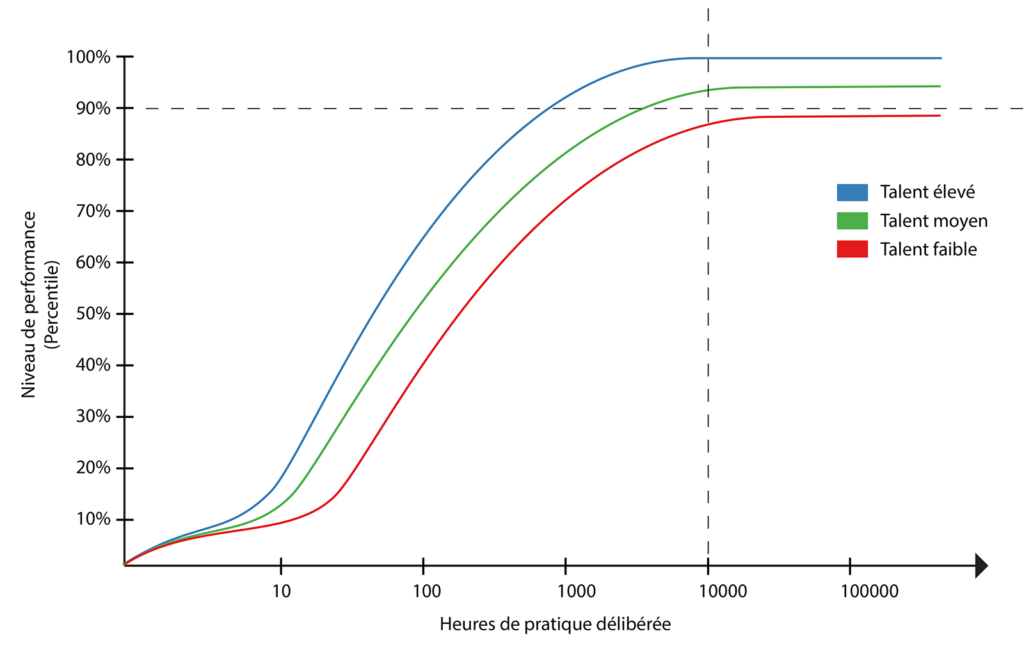
Performance level as a function of deliberate practice and talent. This chart is a conceptual illustration created for the article, not a representation of observed data.
To illustrate my point, I use Malcolm Gladwell’s famous 10,000-hour rule[^1], popularized in his book Outliers, in the chart above. Notice that, regardless of talent level, learning generally follows the same S-shaped curve.[^2] We assume that a highly talented person will reach a higher performance ceiling and will reach it faster than someone with less talent. Their learning curve will be steeper[^3], and their initial learning faster. Because the intrinsic motivation to improve comes from the gains produced by practice, people with less talent may also be more likely to abandon a field or activity than people with greater talent. One point is very important, however: regardless of talent level, everyone can improve and perform at a relatively high level in any field. It always depends on the goal. Becoming the first violinist in an international-calibre orchestra, an Olympic triathlon medallist or a renowned genetics researcher will require great talent and relentless practice beginning at a very young age. With determination and practice, however, anyone can decide to become a violinist, a triathlete or a biology researcher. Don’t believe it? Read the story of Sonia Vallabh and Eric Minikel, who changed careers in their early thirties to become biology researchers and seek a cure for a previously incurable genetic disease affecting one of them. Yes, they really moved from careers in law and urban planning to careers as biology researchers. Think about that story the next time someone tells you they have no talent for science.
(Note 2026-09-02: I still believe practice is the most important factor among those under our control. My position has become more nuanced, however, regarding external factors such as genetics, personal circumstances and disabilities. This demonstration of the biceps insertion point particularly made me think: with the same muscle mass, the position of the insertion point can substantially change the load a muscle can lift because of its mechanical advantage. Practice therefore remains central, but it does not give everyone the same constraints or the same potential.)
Deliberate practice
There is a world of difference between ordinary practice and deliberate practice. Ordinary practice means constantly repeating things we can already do easily. It is pleasant because we remain in our comfort zone and feel in control and capable. Deliberate practice, by contrast, is unpleasant. We have to leave our comfort zone and repeat something again and again with our full attention, which is mentally exhausting. Because we have not mastered the action, it is not especially motivating either. We do not feel in control or competent. Noël Tichy, a professor at the University of Michigan Business School, created three concentric circles to illustrate these practice zones:
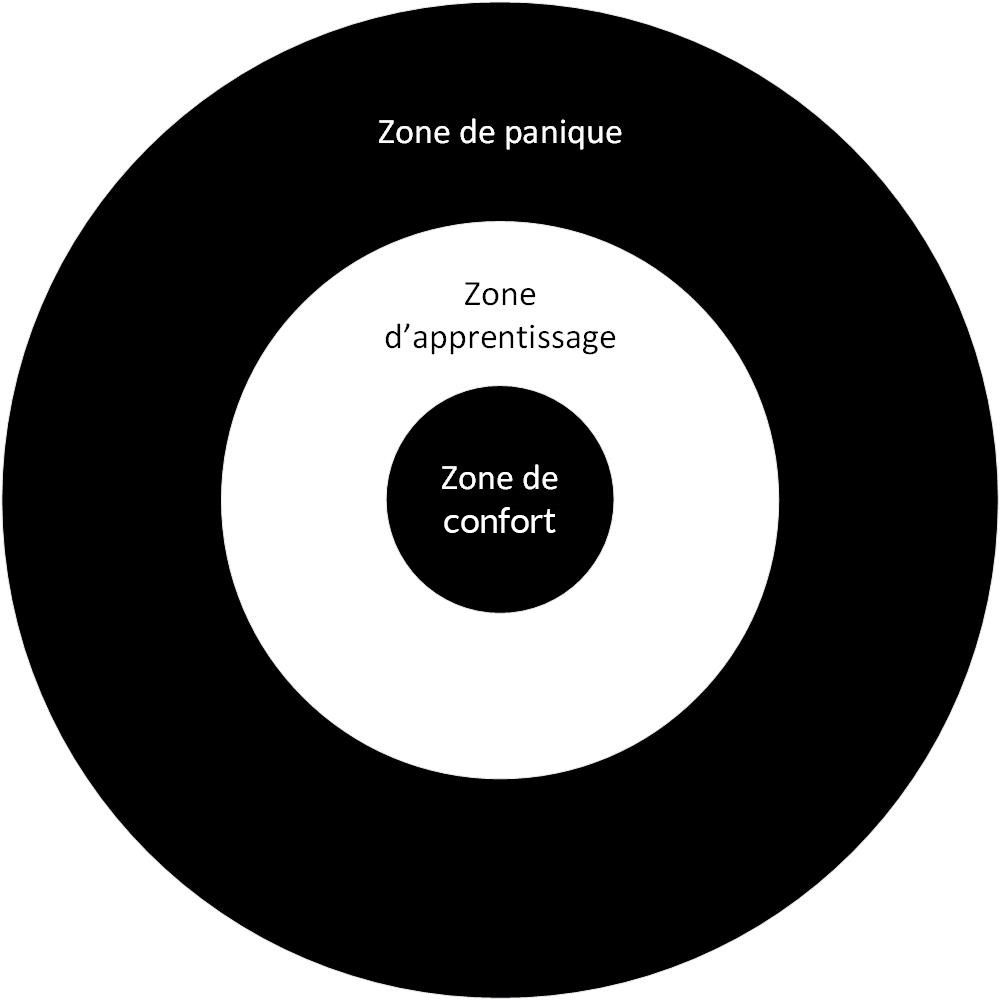
In the comfort zone, we perform well but do not improve. In the learning zone, we do not perform especially well, but deliberate practice produces results and expands the comfort zone. In the panic zone, the task is too difficult and we have no idea how to handle it. When we want to improve, we need to distinguish these three zones because the learning zone is the only one in which we can expect results. A teacher or coach helps keep us in that learning zone, which can be hard to reach through individual practice.
Once we understand the learning zone, we begin to see results, especially if we record our performance at regular intervals. There are many ways to measure performance depending on the field, and I am sure you can imagine one. What matters is choosing a measure and tracking it over time.
What does this change?
The secondary importance of talent compared with deliberate practice changes everything. If we believe that raw talent exists and allows extraordinary people to perform mainly because of an innate ability, it becomes easy to convince ourselves that we lack one talent or another and that trying to perform in a professional or personal field is pointless. If we understand that the most important variable in performance is the time devoted to deliberate practice, however, it means we can accomplish anything if we make the effort. That success can be personal or professional. Professionally, this change in perspective convinced me that I could complete a master’s degree, learn to program and write this blog. Personally, it persuaded me that I could play guitar for fun despite having quit as a teenager. My talent for guitar has not changed, and it is low, but my understanding of talent’s importance has. I can now play well enough to have fun while knowing that I will never be a rock star.
Ultimately, this shift in perspective places responsibility for our performance on our shoulders, not on our genes, chance or luck. We are responsible for taking action in the present to ensure that our future is the one we want. No matter our age, it is never, ever too late!
[^1]: No study has ever confirmed this number, but it is a useful starting point for quantifying the idea of a great deal of practice.
[^2]: Fitts, P. M., & Posner, M. I. (1967). Human performance.
[^3]: Contrary to common usage, a shallow learning curve means learning slowly, while a steep curve means learning quickly. http://www.intropsych.com/ch07_cognition/learning_curve.html