January is often the month when we make plans for the year ahead, whether personal, professional or business plans. The previous fiscal year’s numbers come in, orders slow down, sales forecasts for the coming year are published, and the freezing weather keeps us inside. All of it encourages introspection. I wanted to think about what Bigarade needed to prioritize to maintain its growth in 2018. What better way to begin than with a little Google Scholar research? I found a real gem: Building an integrative model of small business growth by Wiklund, Patzelt and Shepherd (2009).1 If you hold a management position in an SMB, this study is essential reading. It develops an integrative model, meaning one that brings together elements from earlier models, of the factors positively or negatively associated with business growth. There is little jargon, and the results are presented with remarkable clarity and concision. However, because I know most business leaders recoil from reading academic papers, keep reading for a plain-language version of the results!
In this post, I will focus mainly on entrepreneurial orientation. But first, here is the model in all its glory.
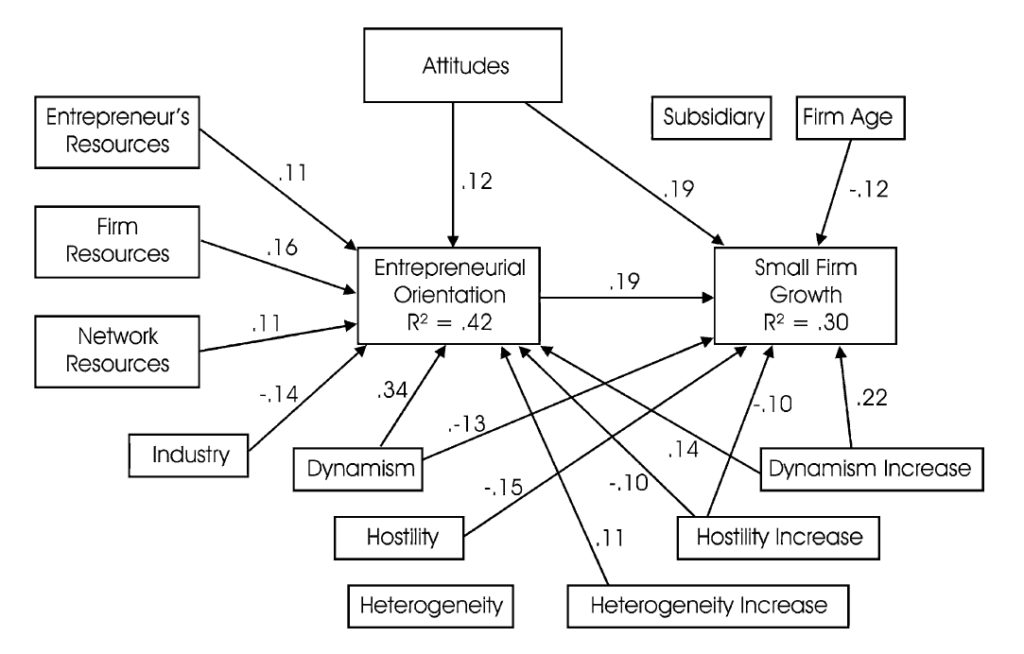
It looks complicated, but it really is not difficult to understand. Start with the two variables explained by the model: entrepreneurial orientation (EO) and firm growth.2 EO acts as a mediating variable in the model. The authors estimate that it transmits part of the effect of the independent factors, such as resources and attitudes, to firm growth. This is excellent news. Although we cannot directly control our company’s growth, we can change its EO! Apart from attitudes toward growth, another factor we can control, and increasing environmental dynamism, which we cannot control, EO also has the strongest effect on company growth in this study. Worth looking into, isn’t it? We will return to attitudes toward growth in part two.
What exactly is EO?
EO has three dimensions: risk-taking, proactiveness and innovativeness. Before continuing, rate your company using the following scale3, and be honest with yourself!
(Note 2026-09-02: This scale is an informal translation published in the original article. It is included as a reflection tool and is not a validated version of the questionnaire.)
| Given the nature of the environment, it is best to explore it gradually through cautious, incremental behaviour. | 1 2 3 4 5 6 7 | Given the nature of the environment, bold acts with broad impacts are useful and common. |
| Our company has a strong preference for low-risk projects with certain but average returns. | 1 2 3 4 5 6 7 | Our company has a strong preference for high-risk projects with a chance of very high returns. |
| Our company has a strong tendency to follow competitors when introducing new products or ideas. | 1 2 3 4 5 6 7 | Our company always tries to lead competitors when introducing new products, and succeeds most of the time. |
| Our firm is characterized by a preference for what has proven effective in the past. | 1 2 3 4 5 6 7 | Our firm is characterized by an orientation toward growth, innovation and development. |
| Our relationship with competitors is characterized by efforts to cooperate and coexist with them. | 1 2 3 4 5 6 7 | Our relationship with competitors is characterized by a tough “Crush the competition” philosophy. |
| Our company places great importance on marketing products and services that have proven successful in the past. | 1 2 3 4 5 6 7 | Our company places great importance on R&D, technological leadership and innovation. |
| Over the past three years, our firm has not brought any new product or service lines to market, excluding minor variations. | 1 2 3 4 5 6 7 | Over the past three years, our firm has brought a large number of new product or service lines to market, excluding minor variations. |
| Over the past three years, changes within product lines have been minor, such as changing a product’s colour. | 1 2 3 4 5 6 7 | Over the past three years, changes within product lines have been major, such as replacing physical buttons with a touchscreen. |
Where does your company fall on a scale from 8 to 56? The higher the score, the higher its EO. If you are already at the maximum, congratulations! Are you surprised by the result? What could you do to improve it?
Once you are done, read my next article about ways to improve a company’s entrepreneurial orientation.
Footnotes
-
Wiklund, J., Patzelt, H., & Shepherd, D. A. (2009). Building an integrative model of small business growth. Small Business Economics, 32(4), 351-374. ↩
-
Firm growth in this study is measured by increases in sales and employee count, as well as by comparing that growth with competitors. ↩
-
Miller, D. (2011). Miller (1983) revisited: A reflection on EO research and some suggestions for the future. Entrepreneurship Theory and Practice, 35(5), 873-894. Informal translation. ↩