What a beautiful store we opened in a South Shore shopping centre that December:
Take a virtual tour of the store
And what a disappointment when we reviewed the results. We reached 25% of the forecast we had initially considered conservative. In other words, it was a monumental failure. We learn from our mistakes, however, and I analyzed why reality landed so far from our projection. Keep reading if you want to avoid falling into the same trap…
We did things properly for our first shopping-centre experience. Of course, we could have improved some aspects of store, inventory and marketing management, but I am genuinely proud of what we accomplished. The Mistake with a capital M, which was largely responsible for the store’s monumental flop, was trusting an aggregate figure provided in the shopping centre’s sales pitch. We projected sales using average annual sales per square foot, without accounting for retail seasonality, and using the shopping centre as a whole, without accounting for store size or type. Relying on this ultra-aggregated figure was a monumental mistake. I am analyzing it after the fact so you can benefit from it. The shopping centre’s representatives seemed quite confident in their estimate, judging by the fairly high sales threshold above which we would have owed them a commission. Thankfully, our lease lasted only one month. Otherwise, the consequences would have been disastrous.
Seasonality and store type
I had considered the seasonal error in the sales estimate and expected an upward bias because December is widely said to account for 20% of annual retail sales. My first mistake was failing to verify that figure. Everyone has heard it, and retailers repeat it as though it were an absolute truth. When we break the data down by industry, it is true that some sectors see a substantial increase, although still nowhere near 20% of total sales. Overall, however, the difference is fairly small.
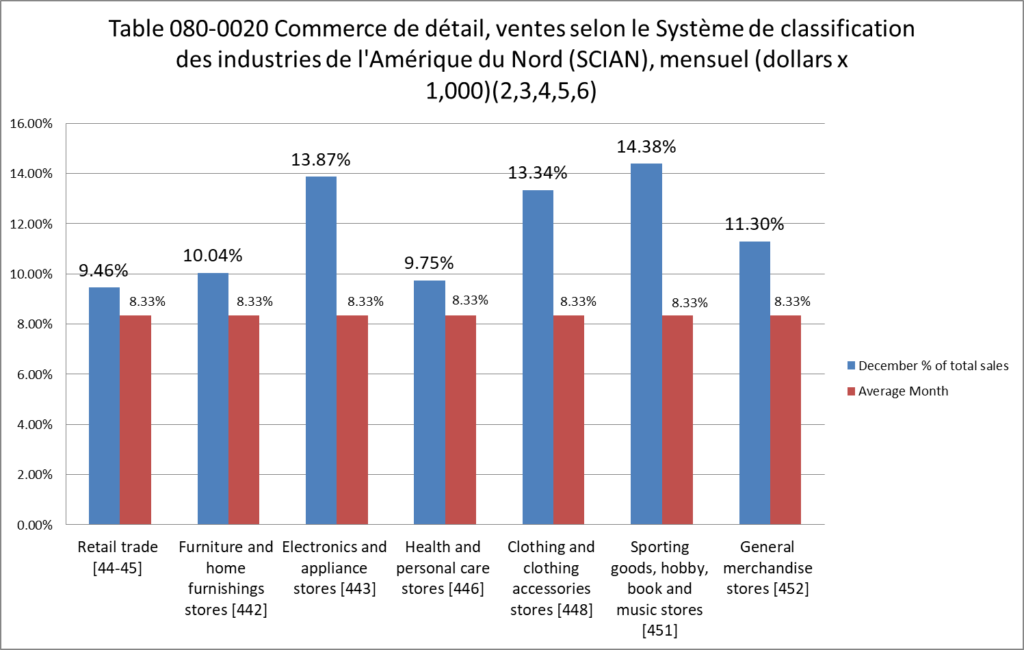
In the end, the December estimate could reasonably have been adjusted upward, but not by very much, because Bigarade’s flagship product was not necessarily a popular gift.
Store size
Then there was the famous aggregate sales-per-square-foot figure, which made no distinction between small and large stores. A 100-square-foot mobile phone kiosk, a 300-square-foot food counter, a 2,000-square-foot SAQ store and a 100,000-square-foot Sears all went into the same basket. With a little thought, it seems fairly obvious that very small stores will optimize their space more effectively and generate more sales per square foot than large ones. When I tried to find a credible source that had studied the phenomenon, however, I found nothing. There was a complete lack of research analyzing sales per square foot by store size, even in Carter’s excellent 2009 literature review on shopping centres.2 I looked for a dataset that would at least let me test my hypothesis, but shopping-centre data appears to be a well-kept secret. I therefore turned to my best friend, Kaggle, and found a dataset covering 45 Walmart stores of different sizes, with total sales over nearly three years. It was not an ideal dataset for finding this kind of relationship because Walmart operates somewhere between enormous and gigantic. I expected the relationship to appear more clearly in a dataset that included very small spaces alongside larger ones without necessarily reaching gigantic proportions. In the end, even Walmart, perhaps the best example of retail optimization, does not escape this trend.
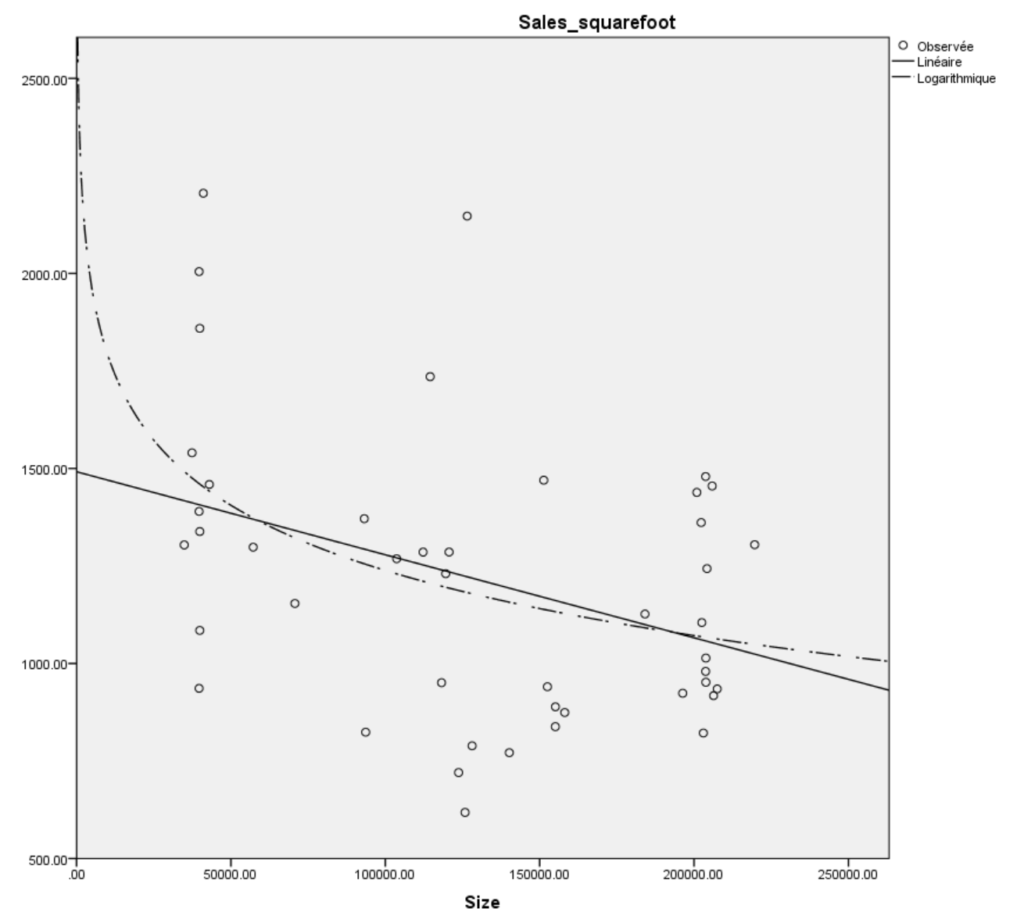
Looking at the dispersion, we can see that this is not necessarily the best dataset for finding the relationship. I can nevertheless confirm that it is significant at p=0.013 (R2 = 0.135) for the linear relationship and p=0.005 (R2 = 0.170) for the logarithmic one. In other words, each additional square foot performs less well than the one before it. I am genuinely surprised that I could not find a study on optimizing retail-store size in relation to the economies of scale provided by a larger space. In Bigarade’s case, however, the 5,000-square-foot store was certainly far too large.
Conclusion
We relied on a single, rather unreliable figure to make all our major business decisions for December, from ordering far too much raw material to closing our Sainte-Catherine Street store for the entire month because we lacked the resources to run both. I will never make that mistake again. Even if we could have kept our store open and avoided ordering too much material, we would still have wasted an enormous amount of time. With those two major consequences included, however, the opportunity cost was far too high. We were not ready to take that risk, and it ultimately did not pay off. Yes, entrepreneurship requires risk-taking, but we will be a little more careful in 2018!
Footnotes
-
Retail trade, sales by the North American Industry Classification System (NAICS) ↩
-
What We Know About Shopping Centers, Journal of Real Estate Literature, Vol. 17, No. 2 (2009), pp. 165-180. ↩