(Note 2026-09-02: The financial figures, company offerings, market shares and observations about online grocery shopping in this article reflect their state in January 2019.)
I was just reading an article about Marché Goodfood’s net loss. More than doubling its subscriber count in a year, from 45,000 to 126,000, is certainly impressive. But how many are real subscribers rather than people simply surfing from one promotion to the next? You have to question the business model of a company with a $4.9 million net loss on $29.6 million in revenue, a loss of 16.6%. That is quite a hill to climb before reaching profitability!
One KPI I would really like to know for Marché Goodfood, and every other meal-kit company, is LTV/CAC, the ratio between customer lifetime value and acquisition cost. With its very aggressive acquisition campaigns, I would bet Goodfood’s ratio was below 1. The usual recommendation is to keep it between 2 and 4. It will take deep pockets to sustain the company until it becomes profitable, which can happen only after a substantial drop in acquisition costs, followed by slower subscriber growth and, of course, unhappy investors! (Note 2026-09-02: This concern about the model’s profitability may not have been completely off the mark. In February 2024, Cook it sought creditor protection before being acquired by Fresh Prep Foods. Maybe this article had a slightly prophetic quality after all.)
I am not a fan of the current business model used by meal-kit companies. I see a great deal of unproductive manual work: filling tiny containers with balsamic vinegar and wrapping individual green onions in plastic bags. Look more closely, however, and the real value of meal-kit companies, which obviously explains their popularity, is not the product itself. It is convenience. There is the convenience of making fewer trips to the grocery store, but above all, there is no need to choose recipes from fragmented websites, write the ingredients on a piece of paper you will lose and then forget half the things you meant to buy at the store.
The large grocery chains had not yet recognized that this was the true value of these companies. Only IGA came close, with an online recipe platform that let users select the missing ingredients from each recipe and add them automatically to their grocery cart. Two major problems kept that platform from reaching its potential:
- The feature itself did not work. When you tried to add several products to the cart, only the first was added as a search that you then had to resolve. If you needed apples, for example, you still had to choose the variety. That is too much friction. The optimal product should already have been assigned to the recipe, such as two pounds of Fuji apples added directly to the cart.
- The platform supported only individual purchases rather than subscriptions, forcing the company to reacquire users constantly.
It would not take much for IGA, or another large chain, to launch its own personalized meal-kit platform, differentiated from the existing players:
- A platform where customers commit to a weekly purchase through a recurring payment that includes free delivery. If they end the subscription with an unused balance, it could be converted into a gift card.
- About ten different recipes offered each week, with customers free to select as many as they want.
- A system that lets customers select only the ingredients they need for each recipe and skip what they already have. No more individually wrapped green onions when the fridge is already full of them!
- Weekly recipe suggestions based on the previous week’s purchases. If someone bought five pounds of potatoes last week, they probably have some left, and the system could highlight a recipe using that possibly remaining ingredient.
This would be an excellent way to retain young, dynamic customers attracted by the convenience of meal-kit services, at a much more reasonable price because of the business model itself. Add a proper automated distribution centre like Tesco’s in England, the only company really doing online groceries well, and you have a real business model capable of earning real profits. I bet Canada’s abysmal 1.3% online share of grocery sales1 would rise quickly! (Note 2026-09-02: This assessment of online grocery shopping and the quoted market share reflect the data and context of 2019.)
Is anyone listening at IGA, Metro, or Sobeys?
UPDATE No. 1
I received several messages about this post. Here is a short clarification I sent to Judith Fetzer at Cook it, my favourite of the bunch…
Hi Judith! My article was never meant as an attack, but rather as an idea for adding value to meal-kit companies’ existing offering. In fact, I changed the wording from “Business model” to “Current offering.” The business model itself is excellent. It is the offering that could be even better. Don’t get me wrong, everyone working in this industry is at the top of their game, and it must be an incredible marketing challenge. You are quite probably the leaders in marketing sophistication. It is also an incredible technical and logistical challenge. I am not questioning any of that! What I find unfortunate is receiving tiny quantities of ingredients I probably already have, the famous example being 10 mL of balsamic vinegar in a plastic cup. If you read the article to the end, I suggest a way to combine meal kits and online grocery shopping, taking the best of both offerings without any of their weaknesses. It would be technically challenging, but considering what you have already accomplished, it is clearly possible.
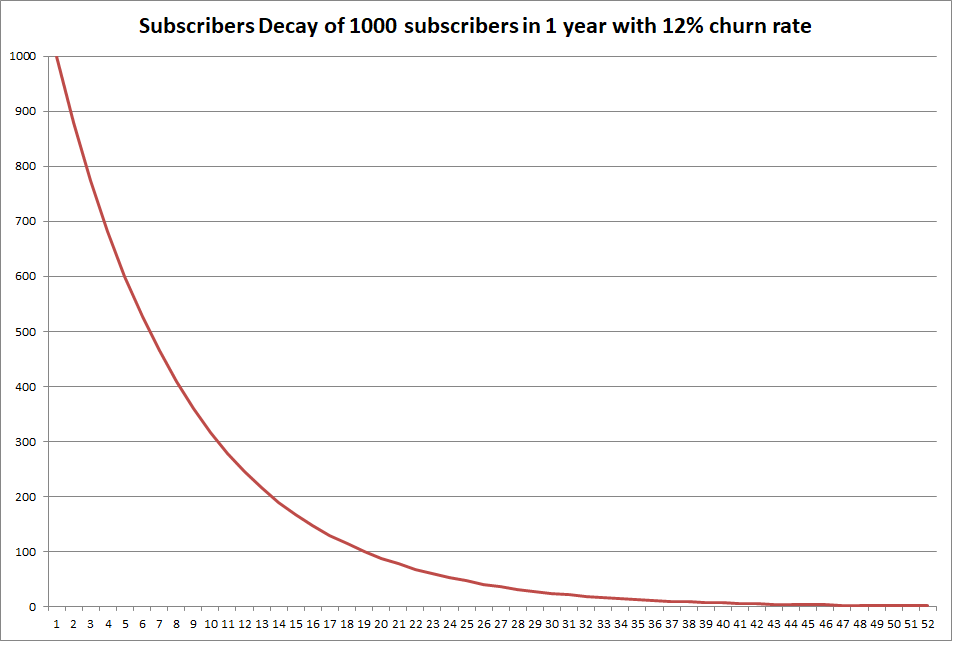
Now, if we talk numbers, what frightens me about this industry is the astonishing churn. Using your figures and assuming an average order of $149, four meals with four servings each, we get weekly churn of 12% for an LTV of $1,200. That is enormous! It means that after one year, of every 1,000 subscribers, one remains. Where did the other 999 go? Did they return to traditional grocery stores or move to a competitor’s attractive marketing offer? It is hard to say. We are a small market, however, and customer acquisition will eventually hit a wall. For Goodfood, the original subject of my article, we have to hope they become profitable before hitting that wall, or exponential churn will hit them first. If you want to discuss this in more detail, I am not here to bash anyone. I simply had an idea that does not apply to my industry and wanted to share it, though I may have done so a little clumsily 🙂
UPDATE No. 2
This article really took off because of the churn analysis, even though its main subject was an idea for extending the service offering. I still need to admit my mistake! I have managed subscription services where statistics were calculated monthly and churn was very low. In those cases, assuming linear churn can work. It is even a very conservative way to analyze the data, and it has the benefit of being easy to calculate.
With higher churn and weekly statistics, however, the situation changes completely because the exponential curve becomes too steep. I was fortunate to have Daniel McCarthy, an assistant professor of marketing at Emory University’s Goizueta School of Business, comment on my LinkedIn post. He is a world authority in this field! He recommended calculating churn in two segments, one with high churn and another with low churn, using secondary credit-card data from Second Measure. Because I do not have access to that kind of secondary data, I considered building a double exponential model in which the original cohort’s churn rate decreases every week. Mr. McCarthy said that this type of model would perform slightly less well than the two-segment model built with secondary data, but would still be valid. A naive model, without data, in which weekly churn decreases by 5% appears to fit Judith’s figures more closely: an LTV of $1,200, an average order of $82, and first-week churn just under 7% that then falls quickly. About 25% of users remain after a year and should stay for good, with churn below 0.5% by the end of the year for that cohort. (Note 2026-09-02: This scenario is illustrative. The weekly 5% decrease is an assumption imposed on the model, not a result estimated or validated from cohort data.)
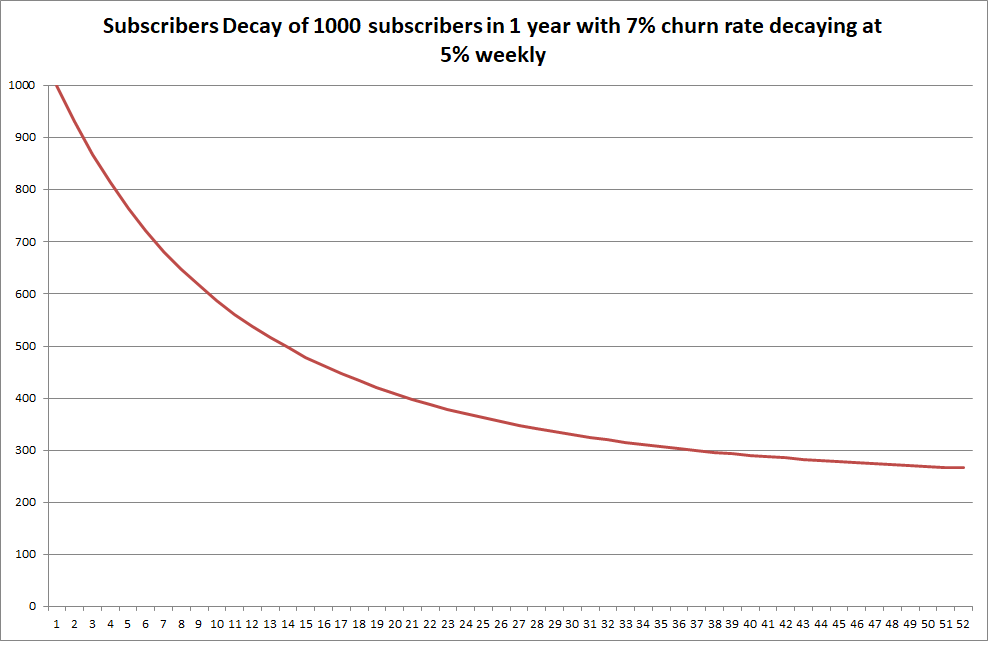
The logic is that a customer who keeps the service for a year is clearly a good fit for it. This is far more intuitive than a linear churn rate. It is also more complicated, but truly necessary at this frequency. It offers a glimpse of the data-analysis challenge in this industry and provides still more evidence that the people working in it are at the top of their game. Hats off to them!
When I have some free time, I will build a model with real data to see whether a double exponential model produces a good fit and avoids the need for secondary data. I will write another blog post about it! If you are as curious as I am, go read Mr. McCarthy’s papers on the subject. That is what I am going to do right now!
Footnotes
-
Nielsen data, Q3 2018 ↩