(Note 2026-09-02: This is an archive from 2019. The products, interfaces, metrics and advertising practices described here reflect their state when the article was published and are not current instructions.)
Where does a digital marketing strategy begin? First, by determining the steps required to reach a specific objective. Strategy gives direction to the implementation of effective marketing tactics. There is no such thing as a bad marketing activity, although keyword stuffing with white text on a white background and following and unfollowing people on Instagram may not be the best ideas, but there is always an opportunity cost. When you do one thing, you are not doing something else. In my case, for example, even though I am not an SMB, I am currently doing content marketing, which means I cannot do something else at the same time. Oops, there is that accounting piling up!
You should therefore take the actions that produce the greatest return for the least effort first. You would not implement a CRM before running simple email campaigns. You would not try selling your product in France before saturating your Quebec market. And so on! This may sound obvious, but I have often seen companies put the cart before the horse and become bogged down in impossible projects before establishing the basics.
Without further ado, here is my basic strategic plan for a company with a clearly defined, recognized brand in its field, I will not cover brand building here, that wants to sell a product with few differentiated attributes and communicates its competitive advantage through its brand.
The framework behind the strategy
To build the strategy, I use the classic AIDA model, which everyone knows either intuitively or formally and which belongs to the broad family of hierarchy-of-effects models. It proposes that a person passes through four stages before making a purchase: Awareness, Interest, Desire, Action.
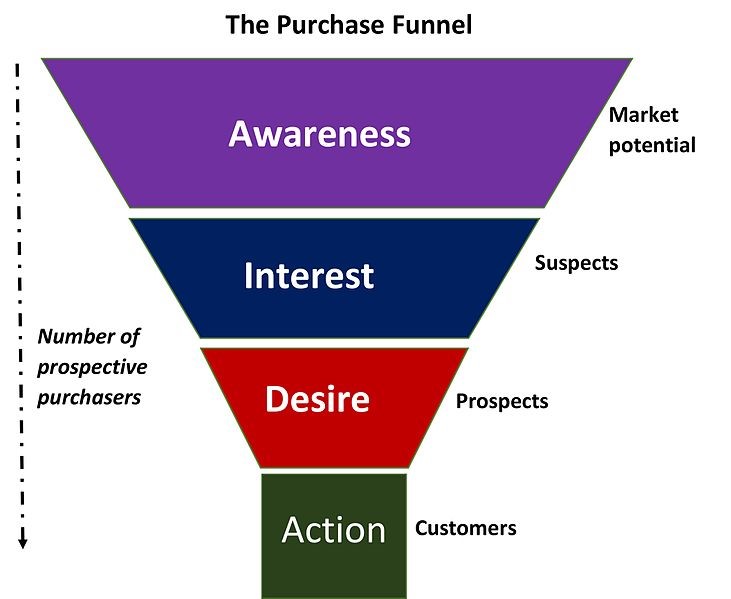

Because this model appears everywhere, many people apply it unconsciously when thinking about the customer’s complete journey. A common line of thought would be: I need to put my brand in front of a customer so they become aware of it. Once the customer knows the brand, I can create cognitive interest in my product by presenting its sustainable competitive advantages. Once they are interested, I can appeal to them emotionally and create desire for my brand. Finally, promotional activities or regular contact can move them to action when they are ready to act.
This way of thinking seems perfectly logical and effective. The customer must know the company before buying from it! For an SMB, however, it is fundamentally wrong for one reason: customers are already in the market right now, looking for a product like yours to satisfy a need. They do not need to know your brand to meet that need. They want to do it simply, quickly and at a good price. When deciding what belongs in the marketing strategy, we should therefore consider the effort and money required to reach each layer:
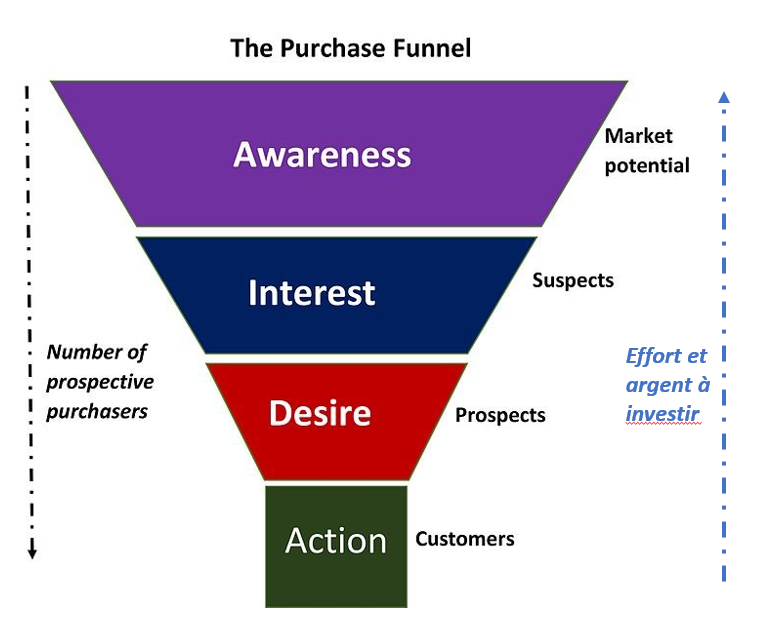
Adding this dimension makes it clear why a massive brand campaign should come last. If you have not mastered the other stages, it will be an expensive waste of effort. Work backward, beginning with the customers most likely to buy. Once you have mastered one layer, move to the next. Before any of that, however, you need to put your house in order.

Stage 0: Analyze and improve the website, implement basic analytics and launch a retargeting campaign
Before anything else, before the first marketing campaign, make sure your honeypot works. There is no point in reaching potential customers if the shopping cart is broken or difficult to use. I am not talking about conversion-rate optimization (CRO) here. We assume there is not enough data for that. A/B testing comes later. Instead, use basic UX principles: reduce friction, organize navigation logically and arrange visual elements according to Gestalt principles such as proximity and similarity. Ask your mother to complete a purchase on the site while saying her internal monologue out loud. Use GTmetrix for suggestions on improving its speed. Organize the navigation through card sorting. Present products simply and professionally in both words and images.
Once that is done, implement Google Analytics. It is difficult to judge a campaign’s return on investment if it is not measured. Configure Enhanced Ecommerce correctly so you know the campaigns’ conversion rates. Create custom Events for your objectives and connect Goals to them. A click on the phone number to call the company, for example, could be a Goal with an assigned monetary value. Enable Search Terms if the site has a search engine so you can understand what its visitors want. Install the Facebook pixel so you can create audiences based on visitor behaviour. (Note 2026-09-02: Google Analytics, Enhanced Ecommerce, Events, Goals and Search Terms are described as they existed in 2019, before the transition to Google Analytics 4.)
Finally, do not let current visitors disappear into oblivion. If someone visits your website, they are interested in the product over the short or medium term. Launch a Facebook Ads retargeting campaign, Dynamic Product Ads work very well, along with a Google Display retargeting campaign. The first encourages action. The second keeps the brand top of mind and familiar through the mere-exposure effect. Facebook ROI is very important and should be high. Google Display ROI is lower because its objective is different. (Note 2026-09-02: The Facebook pixel, Facebook Ads, Dynamic Product Ads and Google Display are described as they existed in 2019.)
Once these three tasks are complete, you are ready for the second stage.

Stage 1: Reach customers who are ready to buy now (Action)
The site is in order, the analytics are running and visitors do not leave without a small reminder of your existence on the other sites they visit. Good! To get short-term results, you are ready to target people who want to meet an immediate need with your extraordinary product. The most effective option here will usually be a search-ad and/or Shopping campaign on Google, or Bing, Amazon, Etsy or eBay, depending on the target.
The idea is to convince people at the Action stage that you are the best supplier for their need. You have the best product and the lowest risk of disappointment. Demonstrate the product’s quality through an excellent description, professional photographs, reviews from previous buyers or endorsements from experts in the field. Reduce perceived risk through free or inexpensive shipping, easy returns and fast delivery.

Stage 2: Reach customers researching your product category (Desire)
This is the time to distinguish yourself from competitors as the brand that knows the subject best. A content-marketing and SEO/SEM strategy lets you answer questions from customers who are not yet ready to buy but are preparing by gathering information. You should not necessarily expect a large ROI at this stage. The objective is to enlarge the pool of customers at the Action stage. Once they visit your site, you can retarget them until they reach the purchase stage. Retargeting is always limited by the number of visitors to the site, so you need a way to increase qualified traffic.
Think about the questions customers ask while researching. If those questions have worthwhile search volume, answer them on the blog. Compare your product’s attributes with those of competing products, and run an SEM campaign targeting competitors’ branded keywords. Create tutorials showing people how to improve their experience with the product category. Do whatever it takes to demonstrate your expertise!

Stage 3: Reach customers comparing different product categories to meet their need (Interest)
This is the stage at which customers assess alternatives and expected value. A customer here is deciding which method to use to meet their need. Take someone who wants to travel from Montreal to Quebec City. At this stage, they are deciding whether to drive, take a bus, fly or travel by train. An airline needs to convince people that its alternative is the best available way to meet the need to travel between the two cities. For a truly brilliant campaign at this stage, look at Via Rail’s campaign by Touché! At stage 2, by comparison, the customer has already decided to take the bus and is looking for the best, least expensive, most comfortable or most reliable company within the bus-transportation category.
This stage is difficult to target and often requires more resources than one company possesses. Some companies therefore join forces to increase their impact within the category. Le Lait is an excellent example. Its objective is to encourage milk consumption over other beverage alternatives. Visit the website and you will see milk promoted for healthy teeth, skin, bones and so on. The hope is that, when someone chooses between a glass of milk and a glass of Coke, they will choose the milk. (Note 2026-09-02: The Le Lait website and campaign are described as they existed in 2019.)
Think about the other players in your category. Would they be open to joining forces in an association that promotes your category over another? A microsite like the one proposed by Le Lait is not out of reach. It also makes sense to think about adding traditional marketing activities to a digital strategy, such as public relations, events or a festival. I can guarantee that nothing helps SEO more than organizing a major event and putting enough effort into public relations for large media outlets to cover it. Bring on the backlinks from domains with 90+ authority!

Stage 4: Become the most recognized and familiar brand in the category (Awareness)
At this point, we move well beyond purely digital strategies. Ask yourself how you could make your name or logo instantly connected with the product category among all your competitors. More difficult still, imagine what you would need to do so that, when someone is asked to name a brand in the category, yours comes first. These are aided and unaided recall, and probably the best metrics to use at this level. Digitally, branded organic searches combined with direct traffic can be a good indication that an Awareness campaign is working.
This is where we bring out the big guns. We want to reach as many people as possible at the lowest possible CPM, as often as possible without becoming annoying. Optimal frequency is a large subject. If it interests you, I recommend this very accessible article by Gerard J. Tellis in the Journal of Advertising Research.1 Digital channels can help here: reach campaigns bought on a CPM basis on Facebook, homepage takeovers on major media sites, pre-roll advertising on streaming sites such as tou.tv, or programmatic advertising. We can even imagine campaigns that are, dare I say it, viral! I love Quebec Original’s entirely digital Un voyage jamais vu campaign. This is clearly tourism branding, with the objective of making Quebec a possible destination in travellers’ consideration sets. (Note 2026-09-02: The advertising formats and platform examples in this paragraph reflect 2019.)
Traditional channels are almost always used at this stage, however. Not everyone is on Facebook, believe it or not! Given the enormous costs of these strategies, creativity is extremely important. Please, someone tell Corbeil Appliances to stop spending hundreds of thousands of dollars on lousy billboards. Be creative and wild, come up with unconventional ideas or hire people who can. A good example of a traditional campaign built around creativity and punch is Valérie Plante’s “L’homme de la situation,” created by upperkut. With fewer resources than her rival, she went from complete unknown to mayor of Montreal in a few months. Quite an achievement for creativity!
Do I need to complete every stage?
Of course not. Many SMBs would benefit enormously from completing only stages 0 and 1 and never going any further. Depending on the size of the market, the type of company and the product category, it may be more effective to stop there and focus on something else, such as developing new products, opening physical stores, optimizing operations or finding investors. There is always an infinite amount of work to do, and none of it is bad! You only need to consider the opportunity cost of every action. If I do one thing, I am not doing another. Sometimes you need to step back and ask: am I doing the right thing to maximize the return on my investment of effort and money? If the answer is yes, you are on the right track!
Does that mean a strategy targeting stage 4 directly, without completing the others, will necessarily fail? Of course not. With equal performance, however, a mass campaign will be more effective if the previous stages are in place. Consider a company fortunate enough to appear on Dans l’œil du dragon, with one million viewers, and that convinces one-tenth of one percent of them to visit its website, or 10,000 people. With a 3% conversion rate, it can expect roughly 300 immediate sales. If the other stages are missing, that is all it gets. If they are in place, however, the company has just created an audience of 10,000 people interested in the product whom it can retarget at stage 0. Those who do not visit immediately will probably search for the product, stage 1, or information about it, stage 2, over the following days, creating more sales opportunities at those stages. Finally, the appearance also demonstrated the relevance of the category compared with other ways to meet a need, which will increase sales from stage 3. This is why companies go into battle-stations mode before appearing on the show. You cannot miss your shot!
What order do you use to prioritize your activities? Do you use a different framework? I am curious to hear your opinion!
Footnotes
-
Tellis, Gerard J., Effective Frequency: One Exposure or Three Factors?. Journal of Advertising Research, pp. 75-80, July-August 1997. Available at SSRN: https://ssrn.com/abstract=906019 ↩